LANCET NanoA local classifier that flags risky Bash commands before an agent or a person runs them.
Results on the 793-command release benchmark
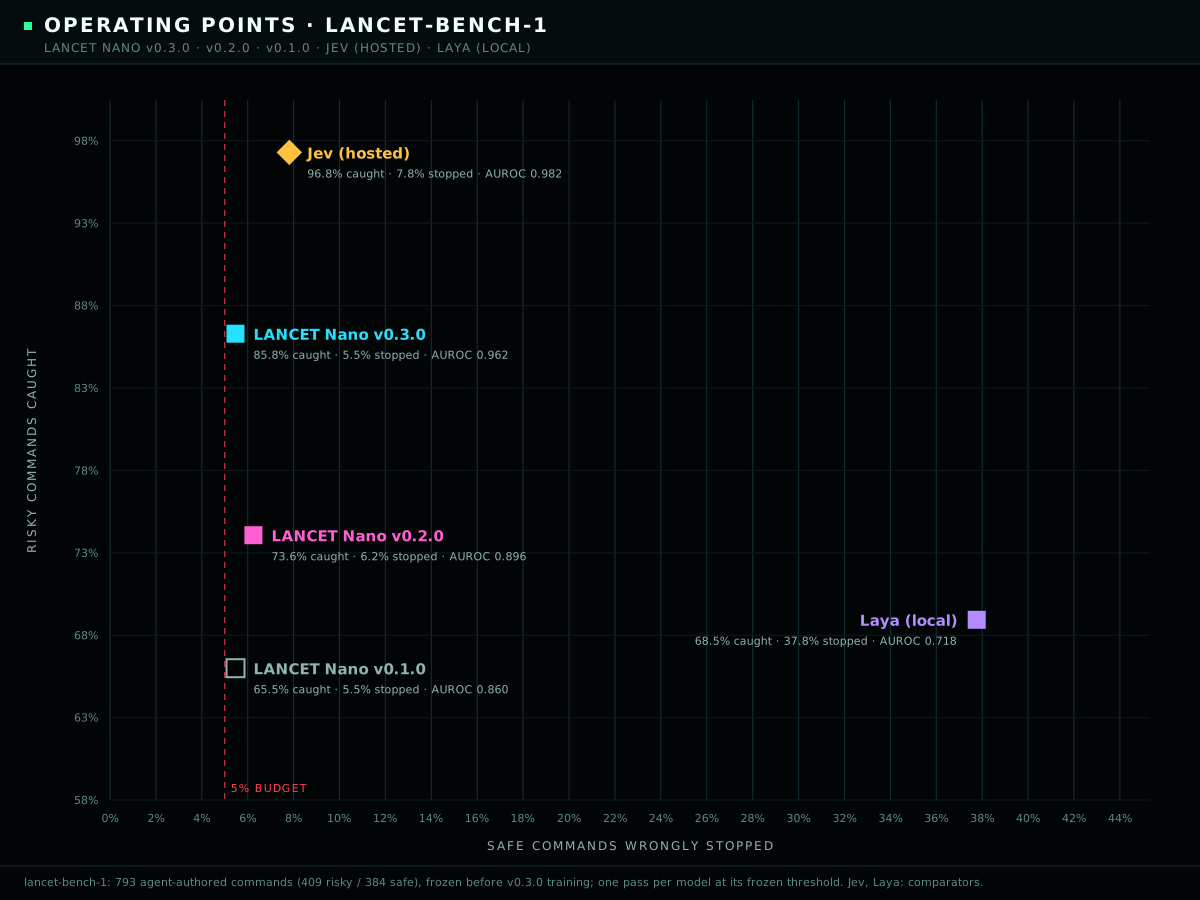
lancet-bench-1: 409 risky and 384 safe commands across 37 tool areas, frozen and screened against all training data before v0.3.0's training data existed.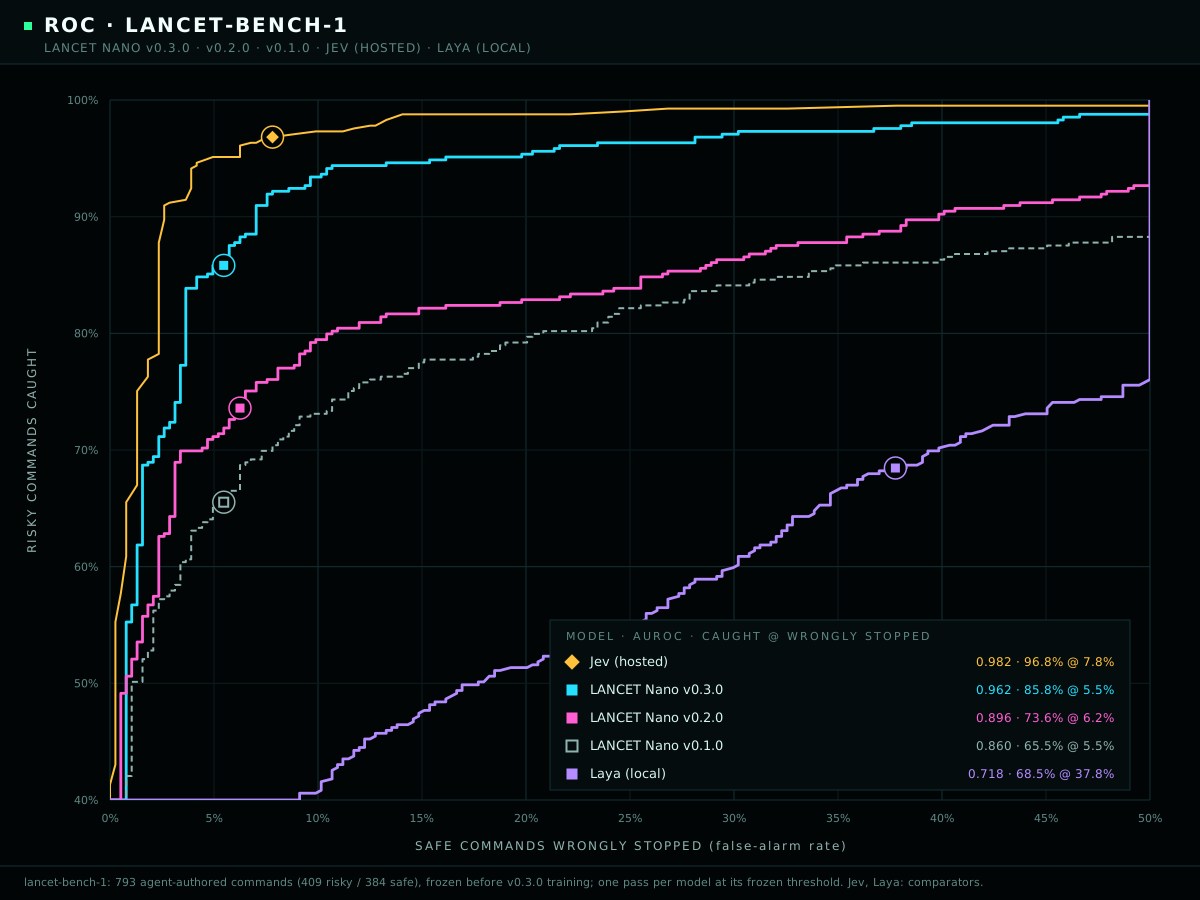
| Model | Risky caught | Safe stopped | AUROC | Secrets caught | Parameters | Runs on |
|---|---|---|---|---|---|---|
| LANCET Nano v0.3.0 | 85.8% | 5.5% | 0.962 | 66% | 110 M | CPU, local, offline |
| LANCET Nano v0.2.0 | 73.6% | 6.2% | 0.896 | 24% | 35 M | CPU, local, offline |
| LANCET Nano v0.1.0 | 65.5% | 5.5% | 0.860 | 14% | 35 M | CPU, local, offline |
| Jev (hosted) | 96.8% | 7.8% | 0.982 | 98% | undisclosed | hosted API |
| Laya | 68.5% | 37.8% | 0.718 | 48% | 421 M | GPU, local |
The benchmark's labels were written by the developer, an AI agent, so this is diagnostic evidence, not independent acceptance. Jev and Laya received a fixed task context; Nano sees only the command.
On the upstream ShellRisk sets (not agent-authored, never trained on), v0.3.0 caught 48.9% vs v0.2.0's 48.3% and stopped 6.3% vs 9.7% of safe commands; on the smaller holdout set it caught fewer (41.9% vs 45.9%).
v0.3.0 was released by owner exception after one overly strict preregistered check (the ShellRisk catch-rate lower bound) failed; the details are in the model card.
Quick start
# 1. verify the download, then the bundle
certutil -hashfile lancet-v0.3.0-nano-cpu-int8.zip SHA256
python verify_bundle.py --strict

# 2. install three pinned CPU dependencies
python -m venv .venv
.\.venv\Scripts\python.exe -m pip install -r requirements.txt

# 3. classify (JSON lines in, JSON lines out)
$env:OPENBLAS_NUM_THREADS = '1'
'{"command": "terraform destroy -auto-approve", "shell": "bash"}' |
  .\.venv\Scripts\python.exe classify.py --model model
{"score": 0.997, "classification": "risky", "reason": null,
"experimental": true, "executionAuthorized": false, ...}High confidence. Block or require explicit approval.
Uncertain or unsupported input. Ask a person.
No risk found. Not a safety guarantee.
- Python 3.12 with NumPy, tokenizers and ONNX Runtime CPU. No PyTorch, no GPU, no API key.
- Keep one process running and stream commands to it; the model loads once.
- Commands are read as text and never executed.
- On macOS or Linux, use
.venv/bin/python. Those platforms were not benchmarked. - If you clone instead of downloading the ZIP: install Git LFS, run
git lfs pull, and usebundle/.
How it was trained
v0.3.0 fine-tunes the Salesforce CodeT5-base encoder from its pinned upstream weights, with no earlier LANCET checkpoint, using class-balanced sampling. Its labels come from project authoring and documentation, not from another model's opinions:
- tldr-pages: each example's one-line description sets the label. "Delete a specific pod" is risky; "List all volumes" is benign.
- AWS botocore: the operation verb, plus AWS's own
sensitivemarkings on returned fields, so commands that print credentials are risky. - Azure CLI, GitHub CLI, kubectl, Docker CLI reference examples, labelled by verb and description, including documented secret reveals such as
keys listand--with-decryption. - LANCET's project-authored risky/safe pairs, a secrets family, earlier agent-authored evaluation suites (retired into training, original labels), and developer commands from SWE-smith, Terminal-Bench and NL2Bash.
| Training source | Rows |
|---|---|
| Project-authored pairs | 9,906 |
| tldr-pages examples | 6,126 |
| Secrets family (project-authored) | 5,328 |
| Retired evaluation suites | 4,358 |
| Developer commands (V5 pool) | 3,054 |
| Azure / GitHub / kubectl / Docker CLI | 1,428 |
| AWS CLI operations | 927 |
No language model, hosted API or human labeler produced any training label.
Development and calibration used tools and families held out from training.
The label rules are heuristic and were not human-adjudicated.
Limits
- Bash only. Nano does not inspect files, fetch scripts or know the task. Other shells, invalid input, more than 8,192 bytes or more than 512 tokens return
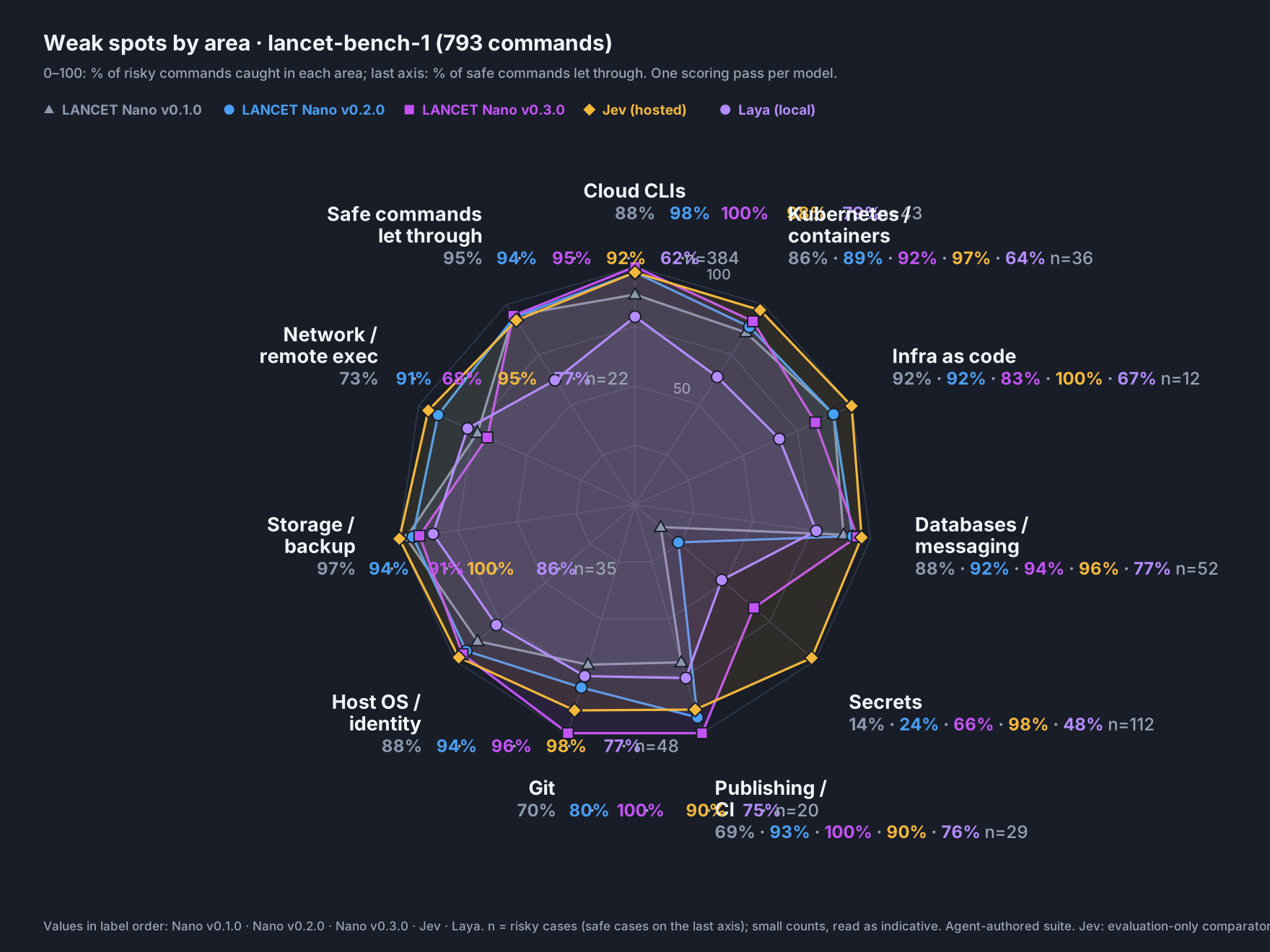
review, with no silent truncation. not_flaggedis not execution authorization or a safety guarantee.- It misses about 1 in 7 risky commands on the release benchmark; secrets (66% caught) and network/remote execution remain its weakest areas.
- v0.3.0 is about 3× larger and slower than v0.2.0, which remains available for tighter footprints.
- The benchmark and much of the training data were written by the same AI agent. Independent acceptance and human label adjudication remain unavailable.
Credits & licenses
Built on Salesforce CodeT5-base by Yue Wang, Weishi Wang, Shafiq Joty and Steven C. H. Hoi (Apache-2.0).
Training commands come from tldr-pages (CC BY 4.0, © the tldr-pages team and contributors), botocore (Apache-2.0, © Amazon.com, Inc. or its affiliates), the Azure CLI and GitHub CLI (MIT), and kubectl and Docker CLI (Apache-2.0), plus the datasets credited in the notices. None of them endorses LANCET.
Model: Apache-2.0. Runtime: MIT. Datasets are not included or relicensed.
See the NOTICE, the third-party notices and the licenses.